The 2051 Moonshot
51%
by 2051.
By 2051, a clear majority of humanity will be measurably flourishing.
A generation from now · A civilizational commitment · Starting today
$1T+
lost annually to depression and anxiety in productivity alone
This does not count the cost in human suffering, broken relationships, or the creative and civic potential that never gets expressed.
WHO Global Mental Health Report · 2022
3 in 5
people report feeling lonely — across every age group and income level
The US Surgeon General declared a loneliness epidemic. The UK appointed a Minister for Loneliness. The data is consistent: connection is collapsing at exactly the moment we need it most.
US Surgeon General Advisory · 2023
~15%Flourishing today
79%Disengaged at work globally
"Most people are not failing at life. They are doing their best inside systems that were never designed for flourishing."
2051The target year
~15%Flourishing today
79%Disengaged at work globally
"Most people are not failing at life. They are doing their best inside systems that were never designed for flourishing."
2051The target year
1 in 4
people globally will experience a mental health condition in their lifetime
And the majority will never receive treatment. The gap between need and access is not closing — it is widening as fast as we are building.
World Health Organization · 2023
~15%Flourishing today
79%Disengaged at work globally
"Most people are not failing at life. They are doing their best inside systems that were never designed for flourishing."
2051The target year
The Challenge
01 — The Challenge
We solved survival.
We never upgraded
how those lives are lived.
In the last century, humanity made staggering gains in survival: vaccines, antibiotics, sanitation, lower child mortality, rising life expectancy. We learned how to keep bodies alive.
But we never upgraded our systems for how those longer lives are actually lived. Many more years are now spent in poor mental health, chronic stress, and social isolation. Work, school, and digital environments drain more energy than they return.
We have stretched lifespan without matching gains in quality of life, meaning, or connection. Our institutions still behave as if the only job is to prevent death — not to cultivate lives worth living.
This is not just a human cost. Populations that feel hopeless, burned out, and disconnected are easier to divide, manipulate, and radicalize — and less able to cooperate on the existential challenges we face together.
A design crisis,
not a moral failing.
Most people are not failing at life. They are doing their best inside systems that were never designed for flourishing — systems built for a different world, now producing predictable and preventable harm.
We act as if exhaustion, anxiety, and loneliness are the inevitable side effects of modern life. They are not. They are the predictable outputs of outdated designs. And that means the problem is solvable.
Schools
Designed for compliance, not curiosity
Still preparing children primarily for industrial jobs that no longer exist in the same way — emphasizing test scores and behavioral compliance over creativity, emotional literacy, and purpose.
Workplaces
Optimized for output, not human beings
Designed for short-term extraction, not long-term health, creativity, or community. The result: burnout, disengagement, and the slow hemorrhage of human potential.
Digital Environments
Rewarded for attention, not wisdom
Platforms designed to capture attention — not to deepen wisdom, foster connection, or support mental health. Their incentives run directly against human flourishing.
Economic Systems
Prioritizing growth over life
Systems that reward consumption and extraction even when these actively undermine mental health and ecological stability. Growth measured without asking what it is growing toward..
Low-Trust, Low-Development Cultures
−9%
Team performance fell among managers with high AI usage
When AI is deployed into cultures that have not invested in trust and development, performance actively declines. The tool does not rescue the culture. It exposes and accelerates what was already broken.
Without human investment → decline
High-Trust, High-Development Cultures
+6%
Team performance rose among managers with high AI usage
When the same tools are deployed into cultures that have invested in trust and development, performance measurably rises. The difference is not the technology. It is the human infrastructure around it.
With human investment → gain. BetterUp Research
U.S., Canada, U.K.
full-time workforce survey
A Living Rhythm
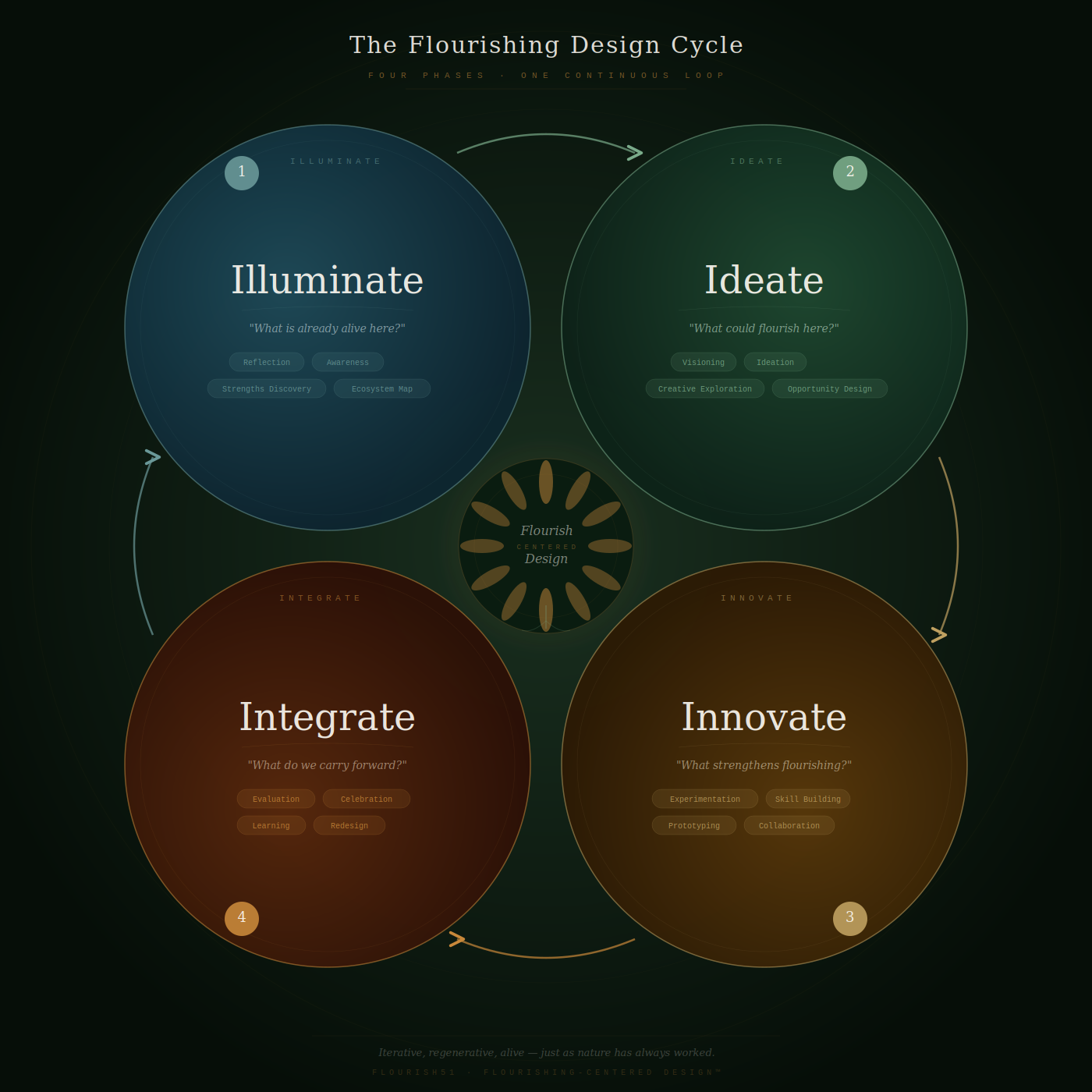
FCD follows a living rhythm — a 4-phase regenerative cycle inspired by the seasons.
It moves the way life moves:
Insight → Possibility → Practice → Renewal
Each phase mirrors how living systems naturally grow, rest, regenerate, and flourish.
This is a living methodology — evolving with the people and systems it serves.
With every cycle, a new season begins. New insight. New growth. Deeper alignment.
For individuals, organizations, and communities alike.
The Case for Flourishing Flourish51 exists to help redesign the conditions of life so that flourishing becomes the norm rather than the exception. Today, humanity faces a paradox: we have extended lifespan and reduced many historic threats to physical survival, yet rising levels of burnout, loneliness, mental distress, and ecological anxiety show that our systems were never updated for how longer lives are actually lived
he 2051 Moonshot is our response to this design gap. Our studio treats flourishing as a public health priority and a design problem. We work at the intersection of positive psychology, systems thinking, and human‑centered design to help organizations, communities, and leaders re‑architect the environments where people spend their lives — schools, workplaces, cities, health systems, and digital spaces — so they actively support well‑being, meaning, and sustainable performance.
Our north star is simple and audacious: by the year 2051, at least 51% of the global population should be able to say, with evidence behind them, “my life is going well and the systems around me help rather than harm.” This threshold matters because when a majority is flourishing, cultural norms, institutional incentives, and political expectations begin to shift toward health instead of exhaustion and scarcity.
Flourish51 partners with mission‑aligned organizations to:
Make flourishing visible and measurable through multi‑domain well‑being indices and dashboards.
Design strengths‑based, nature‑aligned programs, cultures, and experiences that move people from coping to thriving.
Prototype “flourishing ecosystems” in specific contexts (like teams, campuses, or communities) that can serve as proof‑points for wider change.
The studio’s work is guided by one conviction: the crises we face are not just moral or technological, they are fundamentally design problems — and with the right evidence, imagination, and collaboration, they can be redesigned toward a future where human flourishing is our baseline, not our outlier.
The moonshot
51% flourishing by 2051.
The point of the number is not perfection. It is threshold change. Once a majority of people are supported by systems that help them thrive, culture itself begins to bend in a healthier direction.
What counts as flourishing?
Mental and emotional wellbeing strong enough to sustain daily life.
Physical health and energy adequate for meaningful participation.
Reliable social connection, trust, and belonging.
Economic conditions that reduce chronic precarity.
Purpose, contribution, and hope in relation to the future.
Why a majority matters
It changes what feels normal in schools, workplaces, and communities.
It reduces the political power of fear, fragmentation, and despair.
It strengthens resilience for climate, technological, and social disruption.
It makes wellbeing a public expectation instead of a private luxury.
It creates feedback loops where healthier systems produce healthier citizens who demand healthier systems.
Campaign playbook
04 — The Strategy
Treat flourishing
like we treat infectious disease.
Public health succeeded when it stopped only treating disease and started redesigning the environment — clean water, safer food, better housing, vaccination campaigns. We need the same upstream intelligence applied to human flourishing.
I
Make flourishing visible and measurable
Create simple, multi-domain flourishing indicators usable from villages to megacities. Require regular reporting alongside economic and health statistics. What we measure, we learn to manage. If flourishing is invisible in our dashboards, it will always be secondary.
II
Shift from repair to upstream design
Design work with sane workloads, autonomy, and meaningful contribution baked in. Design schools that cultivate curiosity and purpose — not just test scores. Design digital environments that reward truth and depth. Instead of fixing broken people — build environments where people don't break as easily.
III
Put flourishing tools in everyone's hands
Just as public health gave the world handwashing, seatbelts, and vaccines — a flourishing campaign puts simple, evidence-based tools within reach of every person. Emotional regulation. Relationship skills. Purpose practice. Basic health literacy for the inner and relational life.
Build a movement with policy teeth and cultural reach.
An ideal advocacy campaign cannot sound like self-improvement branding. It must pair moral clarity with practical demands: what to measure, what to redesign, what to fund, and what citizens can insist on now.
1. Name the emergency
Frame flourishing erosion as a public risk.
Connect burnout, loneliness, mental distress, civic distrust, and ecological strain as linked symptoms of misdesigned systems rather than separate problems.
2. Make it measurable
Demand flourishing dashboards.
Push cities, ministries, school systems, health agencies, and employers to publish simple multi-domain wellbeing indicators alongside conventional performance metrics.
3. Go upstream
Redesign environments, not just people.
Campaign for healthier defaults in scheduling, urban design, digital systems, education, healthcare access, and work culture.
4. Build public imagination
Make flourishing visible and aspirational.
Use stories, short films, school toolkits, public art, city scorecards, and social media to help people picture what flourishing systems actually look like.
5. Create local proof
Prototype flourishing districts.
Work with one city, one district, one hospital, one employer, or one campus at a time to demonstrate that better design creates measurable gains.
6. Recruit unlikely allies
Make this bigger than one sector.
Bring together public health, mayors, youth leaders, educators, business coalitions, faith communities, designers, and technologists under one common goal.
Policy agenda
Five asks a real campaign could make.
Ask 01
Adopt national and local flourishing indicators.
What gets counted gets governed. Flourishing should sit beside GDP, unemployment, and disease burden in official dashboards.
Ask 02
Fund prevention, not only repair.
Shift resources toward connection, early mental health support, healthy public space, community design, and workplace prevention rather than endless downstream crisis management.
Ask 03
Set wellbeing standards for institutions.
Require schools, employers, and digital platforms to demonstrate how their design choices affect stress, belonging, safety, and human development.
Ask 04
Protect time, rest, and social fabric.
Healthy societies need recovery time, walkable communities, family-supportive policies, and digital environments that do not monetize dysregulation.
Ask 05
Treat climate resilience as a wellbeing strategy.
Ecological conditions are not external to flourishing. Clean air, safe heat, green space, and coModern systems were designed for a world that no longer exists.
M
01
05 — The Coalition
Every sector.
Every role.
One direction.
An effective movement gives everyone a role. The 2051 moonshot needs a coalition that cuts across sectors — not competing programs, but aligned actors in a shared direction.
The message is simple: you do not need permission to start. Every classroom, workplace, clinic, app, street, and household can become a tiny piece of the 2051 solution.
Governments & Public Health
Set the standard
Adopt flourishing indicators as official policy metrics
Fund upstream environmental interventions
Integrate flourishing into public health messaging
Schools & Universities
Develop the whole person
Reorient curricula toward character, collaboration, and well-being
Train educators in strengths-based approaches
Treat student flourishing as a core outcome
Employers & Organizations
Build flourishing into work
Commit to flourishing-positive workplace standards
Measure and publicly report on employee well-being
Recognize that flourishing workers build better outcomes
Tech Companies & Media
Redesign the digital environment
Reduce algorithmic harm and increase measurable benefit
Fund content that builds hope, skills, and solidarity
Collaborate on international standards for digital well-being
Communities & Faith Groups
Hold the human infrastructure
Host spaces for connection, storytelling, and mutual aid
Translate flourishing tools into local cultures
Advocate for policies where their members can thrive
Individuals
Start where you are
Learn basic psychological and relational self-care
Participate in communities that practice mutual support
Use your voice and vote to move toward 2051
The Invitation
Join the
2051 Generation.We refuse to accept a world where most people feel like they are barely coping. We commit to redesigning our systems so that by 2051, a clear majority of humanity can truly flourish.
Commit.
Start with yourself
Treat flourishing as a serious goal — for yourself, your family, your workplace, and your community. Not as a reward for success, but as the orientation from which everything else is built.
Connect.
Find your cohort
Join or create at least one initiative that makes flourishing easier where you live or work. The 2051 moonshot is not a solo project. It is built one relationship, one community, one team at a time.
Create.
Redesign one system
Where you have influence, redesign one system, policy, or space to better support human well-being. One classroom. One team. One policy. One household. Start there.t built the internet, eradicated diseases, and lifteOur current distress is not a verdict on human nature. It is feedback. It is the system telling us that our designs are misaligned — with our biology, our psychology, and the living planet we depend on.d billions from poverty can be marshaled to build cultures where well-being is the default.
Our current distress is not a verdict on human nature. It is feedback. It is the system telling us that our designs are misaligned — with our biology, our psychology, and the living planet we depend on.
"Wake up to the fact that we are all system designers now — and act like it."
The Pledge
"We are the 2051 Generation. We refuse to accept a world where most people feel like they are barely coping. We commit to redesigning our systems — starting with the one closest to us — so that by 2051, flourishing is the norm, not the exception."
I'm in — Contact Flourish51Become an Innovation Partner
The call is not to try harder to be happy. The call is to take seriously the possibility that flourishing is not a luxury, not a privilege, and not an accident — but something that can be deliberately, systematically, and joyfully designed.
Modern systems were designed for a world that no longer exists.
Modern systems were designed for a world that no longer exists.
Modern systems were designed for a world that no longer exists.
Modern systems were designed for a world that no longer exists.
Flourish51
Flourishing-Centered Design™
A Framework for Living Well
Flourishing-Centered Design
FCD is a whole-person, whole-community methodology that treats flourishing — not the management of deficits — as the organising principle of health, education, and community design. It integrates character strengths science with the eight domains of human wellbeing, and applies them through a structured four-phase design process across individual, institutional, and population levels. At its scientific foundation, FCD is built on two converging evidence bases: the VIA Classification of Character Strengths — developed by Peterson and Seligman at the University of Pennsylvania, validated across 35 million people in 190 countries — and the eight interconnected domains of wellbeing that the research literature consistently identifies as the architecture of a flourishing life.
These are not soft concepts. Character strengths predict life satisfaction, academic achievement, workforce engagement, relationship quality, physical health, and resilience under adversity. The eight domains map directly onto the social determinants framework that public health already uses — with the addition of the interior dimensions (spiritual, emotional, physical, creative) that traditional SDOH models tend to underweight.
Key Insight The outer domains of FCD map directly onto the social determinants of health framework — while the inner domains extend that model to include the interior conditions of flourishing that traditional SDOH approaches leave undertheorised. Together, they form a complete architecture for whole person, whole community health.
One of the most important insights of the science is that flourishing is not a single-
domain achievement. Excelling at work while your relationships are starved does not
constitute flourishing. Financial security achieved at the cost of your physical health
does not constitute flourishing. Spiritual depth coexisting with chronic financial crisis
does not constitute flourishing — or at least, not complete flourishing.
A fully flourishing life is one that attends to all eight domains of well-being — not
perfectly, not simultaneously at maximum, but with awareness and intention across the
whole ecosystem of a human life:
I
Systems-Level Impact
Institutional and community transformation, not just individual change
Strengths-based community interventions show sustained improvements in civic engagement, workforce retention, academic performance, and health-seeking behaviour. FCD applies these findings at the design level — shaping the conditions, not just the individuals.
Gallup Workplace Studies; VIA Institute Institutional Research; WHO Healthy Cities Framework
Wellbeing Domains
Eight domains that predict whole-person health outcomes
The spiritual, emotional, physical, creative, social, environmental, occupational, and resource domains map directly to known social determinants of health — with the addition of interior dimensions that drive meaning, agency, and resilience at both individual and community level.
VIA Institute; WHO Social Determinants of Health Framework; Huppert & So, 2013
Character Strengths Science
The most robust positive predictor of population wellbeing
Hope, zest, and gratitude show correlations with life satisfaction of r=.53, .52, and .43 respectively — comparable in effect size to major clinical interventions. Regular strengths use predicts lower depression, better physical health, and stronger social connection.
Park, Peterson & Seligman, 2004 (n=3,907); VIA Institute Global Data
24
Character
Strengths
8
Domains of
Well-Being
4
Seasonal
Design Phases
51%
Humanity
Flourishing · 2051
24 Universal Character Strengths
The empirical foundation
of strengths-based design
Validated across cultures and contexts — these are the universal human strengths that FCD maps, cultivates, and deploys as the primary tools of flourishing design.
Creativity
Curiosity
Judgment
Love of Learning
Perspective
Bravery
Perseverance
Honesty
Zest
Love
Kindness
Social Intelligence
Teamwork
Fairness
Leadership
Forgiveness
Humility
Prudence
Self-Regulation
Appreciation of Beauty
Gratitude
Hope
Humor
Spirituality
A design-based methodology that helps individuals, organizations, and communities move beyond optimization — toward regeneration. The goal is to design environments where human potential becomes a renewable source of growth.

THE MOONSHOT
By 2051, 51% of the world’s population will be flourishing.
“To flourish means to live within an optimal range of human functioning, one that connotes goodness, generativity, growth, and resilience.”


The Flourish51 Evolution
The concept of Flourish51 has its beginnings as the founder’s deep immersion into the science of human flourishing in 2018. Her desire to put the evidence into practice led to a self-experiment which served as the backbone of her certifications as an applied positive pscyhology practitioner, educator and coach.
Launched in 2021 as a low-fidelity prototype, Flourish51 began as a human-centered design studio grounded in well-being science and strengths-based psychology, inspired by the global goal of: 51% of humanity flourishing by 2051.
After 5 years of applied work across social impact, equity, and well-being design, Flourish51 evolved into Flourish51 Version 2.0— a living prototype of flourishing-centered design.
Flourish51 is powered by a community of brilliant advisors & collaborators all with diverse strengths and expertise—all committed to our 51 by 51 movement—a world where most are thriving by 2051.

The Design Principle l Flourishing Centered Design
Three bodies of knowledge.
One design system.
Flourishing-Centered Design (FCD) is grounded in three converging sciences: positive psychology's evidence on character strengths, human-centered design's discipline of building for real human needs, and the design intelligence found in nature's most resilient systems.
Each reinforces the others. Together, they form a novel, interdisciplinary design methodology — FCD.
01
The Science of Human Flourishing
Cutting-edge research from positive psychology—an evidence-based understanding of what conditions actually produce flourishing, with an emphasis on strengths science.
02
Nature selects for full expression of strengths & flourishing happens in biodiverse ecosystems where organisms have optimal conditions to express their unique strengths.
03
Rigorous, evidence-based methodology for creating solutions that place human needs, behaviors and experiences as the foundation for design

"Good design solves. Soulful design illuminates — what's possible, what's present, what's ready to flourish."
Flourish51 · Design with Soul
WHAT THE SCIENCE SAYS
The Design Principle
Flourishing-Centered Design is grounded in three converging sciences: positive psychology's evidence on character strengths, human-centered design's discipline of building for real human needs, and the design intelligence found in nature's most resilient systems.
Science in
service of
flourishing.
Flourishing-Centered Design is built on decades of rigorous research. Every intervention, every program, every tool traces back to findings this powerful. These are the numbers that shape everything we do.
The most evidence-based intervention
in positive psychology.
Gallup's global research shows employees who use their strengths every day are six times more likely to be engaged at work — and three times more likely to report excellent quality of life.
Gallup Strengths Research, 2015–2023Teams using strengths-based approaches show measurable gains in output and profitability, beyond engagement alone.
Gallup Business Journal, 2016Organizations that deploy strengths-based management see consistent improvements across retention, productivity, and customer outcomes.
Gallup, 2022 Global Workplace ReportPeople who can name their top strengths are three times more likely to have an excellent quality of life.
When people can articulate what they are best at — and deploy those strengths deliberately in the context of their work and life — the results are not marginal. They are transformational. This is why strengths identification is the first move in every FCD engagement.
Gallup · "Strengths-Based Development" · 2023The VIA framework is among the most replicated and validated instruments in positive psychology research.
VIA Institute Research Compendium, 2023Early strengths identification accelerates coaching outcomes and deepens self-efficacy from session one.
Linley & Harrington, 2006 · Int'l Coaching Psychology ReviewStrengths-based approaches are especially powerful in youth development contexts — forming the foundation of the FYA curriculum.
Park & Peterson, 2008 · Journal of Positive PsychologyHope and optimism — two core components of psychological capital — reliably increase when strengths work is done with intention.
Proctor et al., 2011 · Journal of Happiness StudiesThe Set Point Theory of Happiness, updated by Lyubomirsky, Sheldon & Schkade (2005), showed that roughly half of our happiness setpoint is changeable through deliberate, strengths-aligned activity. This is the scientific window through which FCD operates.
Lyubomirsky, Sheldon & Schkade, 2005 · Psychological BulletinGallup's global workforce data consistently shows that disengagement is the default. But teams that receive strengths-based leadership and development reverse this pattern, showing higher output, lower absenteeism, and higher customer satisfaction ratings.
Gallup State of the Global Workplace Report, 2023
The state where strengths
and challenge converge.
When executives reported being in flow, they were five times more productive than in their normal state. Csikszentmihalyi's theory, validated at scale.
McKinsey Quarterly, 2013 · "Increasing the meaning quotient of work"Flow reliably unlocks non-linear problem-solving and pattern recognition. This is why Innovate — FCD's Summer season — is specifically designed to generate flow conditions.
Csikszentmihalyi, 1990; Creativity Research JournalDARPA-funded research on flow in learning contexts found subjects learned new skills at four times the normal rate during flow states.
Advanced Brain Monitoring / DARPA, 2012Despite intuition that happiness comes from rest, Csikszentmihalyi's Experience Sampling Method showed that people report their highest moments of meaning, engagement, and joy during states of focused, strengths-aligned challenge. This is the experiential target of FCD — not comfort, but aliveness.
Csikszentmihalyi, 1997 · Finding Flow; ESM Studies across 50 yearsFlow is one of the few states that simultaneously activates multiple performance-enhancing neurotransmitter systems. It is neurobiologically distinct from both rest and stress.
Kotler & Wheal, 2017 · Stealing Fire; Neuroscience of Peak PerformanceOf people who regularly experience flow report significantly higher life satisfaction — regardless of domain or occupation.
Flow is domain-independent and available to everyone. It is not reserved for artists or athletes. It occurs whenever challenge matches skill and attention is fully absorbed. FCD's design rhythm — particularly the Innovate season — is deliberately structured to create the conditions where flow becomes more frequent, more accessible, and more intentional.
Csikszentmihalyi & LeFevre, 1989; Updated meta-analysis, Peifer et al., 2020
The architecture of a
flourishing mind.
Dweck's landmark research across Stanford, Columbia, and global replications consistently shows that the belief that abilities can be developed predicts real-world performance differences that compound over time.
Dweck, 2006 · Mindset; Blackwell, Trzesniewski & Dweck, 2007Resilience — the capacity to recover from difficulty — is one of the most trainable human capacities. Mindset interventions produce durable gains at any age.
Yeager & Dweck, 2012 · Perspectives on Psychological ScienceShawn Achor's research across KPMG, UBS, and dozens of Fortune 500 organizations showed that positive emotion precedes performance — it is not a reward for success, but a catalyst for it.
Achor, 2010 · The Happiness Advantage; Harvard Business Review meta-analysisPsyCap — a composite of hope, efficacy, resilience, and optimism — is one of the strongest organizational predictors of flourishing. And it is developable through intentional design.
Luthans et al., 2007 · Psychological Capital; Journal of Occupational HealthDanner, Snowdon & Friesen's (2001) longitudinal study of 180 nuns found positive emotional tone in early writing predicted significantly longer life — one of the most cited findings on the physical effects of positive psychology.
Danner, Snowdon & Friesen, 2001 · Journal of Personality and Social PsychologyThis is the direct inspiration for Flourish51's moonshot. Not wishful thinking — a scientific projection grounded in decades of research on what actually shifts human well-being sustainably.
Seligman, 2011 · Flourish; Positive Psychology Center, University of Pennsylvania
Design thinking at the scale
of human systems.
The Design Management Institute's "Design Value Index" tracked design-led organizations against the broader market over a decade. Design thinking is not aesthetic preference — it is a performance multiplier with measurable financial outcomes.
Design Management Institute / InVision Design Value Index, 2015–2018Speed and iteration are built into HCD's DNA — and this translates into real-world competitive advantage.
IBM Design Thinking Field Guide, 2018Empathy-first, iterative design processes reduce costly rework and false starts across industries.
IBM Institute for Business Value, 2018Design thinking develops not just outputs but processes — and the relational quality of teams who practice it together measurably improves.
IDEO / Stanford d.school Research, 2020When the people being served are brought into the design process, the quality and adoption of solutions dramatically improves — a finding with deep implications for social impact work.
NESTA / UNDP, 2019 · HCD in Social InnovationMcKinsey's landmark analysis of 3,000+ organizations found that the human dimension is the defining variable in transformation outcomes. This is precisely the gap FCD is designed to fill — bridging design methodology with the human science of well-being, strengths, and psychological safety to address the real root cause of organizational failure: people who are not flourishing.
McKinsey & Company, 2019 · "Losing from Day One"FCD is the first methodology to fully integrate human-centered design with strengths-based positive psychology into a single, repeatable system.
Every science on this page has existed in isolation. Strengths researchers don't design systems. HCD practitioners don't measure flourishing. Flow theorists don't build seasonal cycles. Flourishing-Centered Design is the first framework to combine all of it — to put these powerful scientific findings into active, measurable practice across life, work, and community.
Flourish51 · Flourishing-Centered Design Methodology · Phase 2 Launch, June 2026All of this science.
Put into practice.
Every engagement. Every season.
FCD translates decades of rigorous research in character strengths, flow state, mindset science, and human-centered design into a single, repeatable methodology — applied at the scale of a life, a family, or an organization.